
2026 Best Custom Printed Floor Options for Global Buyers?
For global buyers, choosing a printed floor in 2026 involves more than matching colors to a campaign. Custom Printed Floor solutions now support retail launches, exhibitions, hospitality spaces, museums, and temporary brand environments. Buyers must compare visual quality, slip resistance, installation time, cleaning needs, and end-of-use plans. A vivid floor may attract visitors, yet poor edge finishing can create trips and costly replacements. That detail matters. Experienced sourcing teams inspect printed samples under warm and cool lighting before approving production. They also request documented material specifications, test reports, and clear tolerances from suppliers. Claims should be verifiable.
This guide reviews major custom floor options, including printed vinyl, carpet tiles, rubber surfaces, interlocking panels, and recyclable textile systems. Each format serves a different site condition. Vinyl can deliver sharp graphics and quick cleaning. Carpet tiles may reduce sound in busy showrooms. Rubber can provide resilience where equipment and foot traffic are demanding. Modular systems often simplify repairs, because one damaged section can be replaced instead of the full floor. Still, sustainability language requires care. Recyclable does not always mean recycled, and local collection access may be limited. Buyers should ask where materials are made, how inks are cured, and what happens after removal.
Regional standards, fire classifications, accessibility requirements, and installer qualifications can change the final decision. A reliable supplier explains these differences without overstating performance. Request a small trial area. Walk across it. Observe glare, seams, odor, and cleaning response. The “best” option is rarely universal. It depends on the venue, budget, schedule, and measurable risk. Some recommendations may need revision after real-world testing, but that is a responsible part of professional procurement.
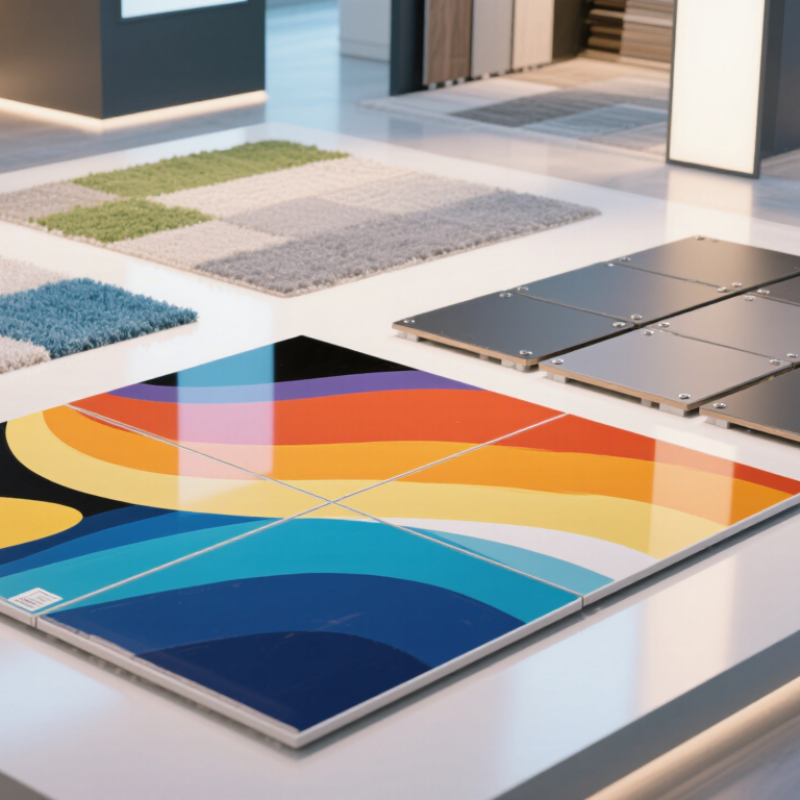
Custom Printed Flooring: Definition, Uses, and 2026 Market Context
Custom printed flooring is a floor surface produced with a tailored image, pattern, logo, or color arrangement. It combines a functional base with visual communication. Common bases include vinyl, carpet tile, rubber, and coated composite materials. Printing methods vary by substrate, traffic level, and required image detail. A sharp design means little if the surface wears quickly.
Its uses extend across retail interiors, exhibitions, hospitality spaces, sports venues, offices, and educational facilities. A printed entrance can guide visitors, while a temporary event floor can create a strong visual setting. In busy corridors, buyers should examine abrasion resistance, slip performance, cleaning requirements, and color stability. I have seen attractive samples lose impact under harsh lighting or frequent trolley traffic. That gap deserves attention.
The 2026 market is moving toward shorter production runs, more regional sourcing, and digitally customized designs. Global buyers increasingly compare lead times, installation systems, material documentation, and end-of-use options. Digital printing supports detailed graphics without requiring large volumes, but costs can rise with complex finishes and strict color matching. Screen samples may also differ from large installed areas. A small test panel is useful. No specification is perfect. Buyers should request technical data, fire-performance information, maintenance guidance, and realistic delivery terms before approving production. Availability can differ sharply between regions, so local installation expertise remains important.
2026 Best Custom Printed Floor Options for Global Buyers? - Custom Printed Flooring: Definition, Uses, and 2026 Market Context
| Custom Printed Flooring Option | Typical Construction | Best-Fit Applications | Common Print Method | Typical Format | Expected Service Profile | Key Buyer Advantage |
|---|---|---|---|---|---|---|
| Printed Vinyl Roll Flooring | PVC wear layer, printed décor layer, backing layer, and protective finish | Retail displays, exhibitions, events, hospitality interiors, promotional floors | Digital inkjet or rotogravure printing | Continuous rolls; commonly supplied in widths of approximately 2–4 m | Good visual impact; surface durability depends on wear-layer thickness and traffic level | Large graphics with relatively efficient installation over broad areas |
| Printed Vinyl Tiles and Planks | Multi-layer resilient flooring with a printed design and protective wear layer | Retail stores, offices, schools, healthcare spaces, branded interiors | Digital or gravure printing with a factory-applied coating | Modular tiles or planks; common modules include square and rectangular formats | Individual units can be replaced; suitable for moderate to heavy commercial traffic when correctly specified | Simplifies phased installation, repairs, and future layout changes |
| Printed Carpet Tiles | Tufted or fusion-bonded textile surface attached to a bitumen, PVC, or cushion backing | Corporate offices, hotels, meeting areas, educational facilities, retail zones | Digital textile printing or solution-dyed pattern production | Mostly modular tiles, often around 50 × 50 cm or 25 × 100 cm | Acoustic and underfoot comfort benefits; damaged tiles can usually be exchanged individually | Supports complex patterns while helping reduce installation waste |
| Printed Entrance Matting | Polyamide or polypropylene pile bonded to a rubber, vinyl, or textile backing | Building entrances, hotels, offices, retail stores, transport facilities | Dye injection or digital textile printing | Cut-to-size mats and modular mat tiles | Designed to capture dirt and moisture; performance depends on fiber type, backing, and maintenance | Combines wayfinding or branding graphics with a functional entrance barrier |
| Printed Rubber Flooring | Natural or synthetic rubber with a printed or factory-patterned surface | Gyms, schools, healthcare areas, public buildings, corridors | Surface printing, inlay, or molded pattern technology | Sheets, rolls, or tiles | Resilient, slip-resistant options are available; chemical and indentation resistance must be confirmed for each specification | Suitable for demanding areas where impact absorption and comfort are important |
| Printed PVC Event Flooring | Flexible PVC sheet with a digitally printed surface and protective clear coating | Trade shows, sports events, product launches, temporary retail spaces | Large-format digital printing | Rolls, cut panels, and interlocking temporary sections | Fast visual transformation; reuse depends on thickness, installation method, and handling | Strong choice for short-term campaigns and rapidly changing layouts |
| Printed Outdoor Floor Graphics | Outdoor-rated PVC, polyester, or textured anti-slip media with protective lamination | Outdoor promotions, pedestrian guidance, festivals, sports venues, temporary installations | UV-resistant digital printing with optional overlaminate | Sheets, panels, decals, or modular sections | Weather and slip performance vary considerably; outdoor certification and site testing are important | Extends custom floor communication beyond indoor environments |
2026 Global Buyer Comparison Metrics
| Buyer Decision Dimension | What to Confirm Before Ordering | Practical 2026 Purchasing Guidance |
|---|---|---|
| Traffic and Wear | Commercial classification, wear-layer thickness, abrasion resistance, indentation resistance, and expected daily traffic | Do not select a product by image quality alone; match the construction to the actual traffic category |
| Slip and Fire Safety | Slip-resistance test method, reaction-to-fire classification, smoke requirements, and local building regulations | Request test reports that apply to the finished printed surface, not only to an unprinted base material |
| Indoor Air Quality | VOC emissions, adhesive emissions, phthalate status where relevant, and indoor-air certification | Prioritize low-emission specifications for schools, healthcare projects, offices, and hospitality interiors |
| Sustainability | Recycled content, material composition, take-back options, environmental product declarations, and end-of-life route | Compare the entire flooring system, including backing, ink, coating, packaging, installation, and disposal |
| Color and Image Accuracy | Color profile, proofing process, repeat tolerance, minimum resolution, and batch consistency | Approve a physical strike-off or production sample before releasing a large international order |
| Installation and Maintenance | Subfloor flatness, moisture limits, adhesive compatibility, seam treatment, cleaning chemicals, and repair method | Specify installation instructions for the destination country and require compatibility with local contractors |
| International Logistics | Roll or carton dimensions, gross weight, packaging protection, customs classification, Incoterms, and replacement policy | Calculate landed cost rather than factory price alone, especially for oversized rolls and urgent project schedules |
Note: Specifications, dimensions, performance ratings, regulatory requirements, and service life vary by construction and jurisdiction. Buyers should verify current technical data sheets, test reports, and installation requirements for the exact finished product before purchase.