
Top 10 Types of PU Foam Sealant for Global Buyers
Choosing the right PU foam sealant is rarely a simple purchasing decision. Global buyers must examine expansion rate, curing speed, adhesion, density, and moisture resistance. A product that performs well around a dry interior window may fail on a cold, moving façade.
This guide compares ten practical types, including low-expansion foam, gun-grade foam, straw-applied foam, fire-rated foam, waterproof foam, winter-grade foam, adhesive foam, flexible foam, door-and-window foam, and specialty construction foam. Each type serves a different job. Some fill narrow gaps neatly. Others expand aggressively and can distort frames. Read the technical data sheet carefully. Small details matter.
Edward M. Petrie, a recognized adhesives and sealants specialist and author of technical reference works, offers a useful principle: “Sealant performance depends on matching the material to the joint, the substrate, and the service conditions.” That principle guides this overview. It also exposes a common mistake: treating all PU foam sealant products as interchangeable. They are not.
The ranking is practical, not absolute. Climate, packaging quality, applicator skill, and storage temperature can change results. Even experienced contractors occasionally choose the wrong foam. That deserves reflection. A cheaper can may create trimming waste, air leakage, or costly rework later. Buyers should verify certification claims, curing instructions, shelf life, and regional standards before placing large orders. The best choice is not always the fastest-expanding product. It is the one that remains stable, bonds reliably, and suits the actual installation environment.
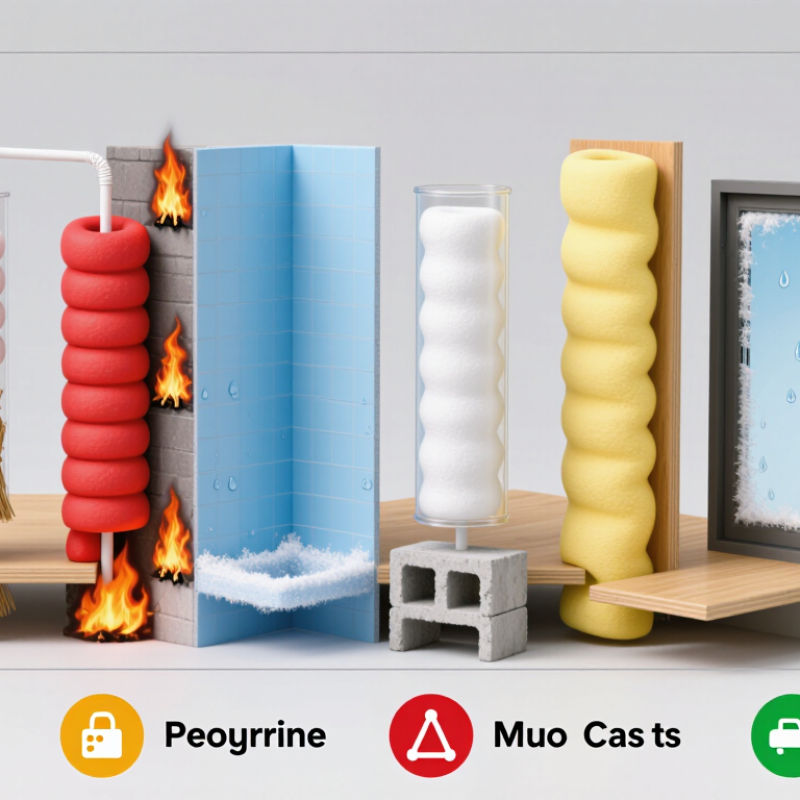
PU Foam Sealant Basics and Classification
Top 10 Types of PU Foam Sealant for Global Buyers
PU Foam Sealant Basics and Classification
PU foam sealant is a moisture-curing material that expands after dispensing. It fills gaps around windows, doors, pipes, panels, and irregular joints. The main classifications include one-component and two-component foam. One-component foam cures with air humidity. Two-component foam uses a separate activator and usually cures faster.
Buyers also compare low-expansion, standard-expansion, and high-expansion grades. Low-expansion foam offers better control near delicate frames. High-expansion foam covers larger cavities but can create pressure if overfilled. Other useful categories include fire-rated, flexible, adhesive, gun-grade, straw-grade, and all-season formulations. The boundary is not always clean. A product may fit several categories.
Tips: Check the technical data sheet before purchasing. Compare curing time, expansion ratio, density, temperature range, and yield. Test a small area first. Surface moisture matters, but excessive water can weaken results. Store cans upright and avoid extreme heat. Packaging size alone does not prove performance. Requirements also vary by country, climate, and building practice, so local compliance documents deserve careful review. Even experienced installers sometimes misjudge expansion in deep cavities. Leave room for movement and avoid treating every gap as identical.
Top 10 Types of PU Foam Sealant for Global Buyers - PU Foam Sealant Basics and Classification
| No. | PU Foam Sealant Type | Main Classification | Curing Mechanism | Typical Application | Typical Technical Characteristics | Key Advantages | Important Buying Considerations |
|---|---|---|---|---|---|---|---|
| 1 | One-Component Moisture-Cured PU Foam | 1K aerosol foam | Reacts with moisture in the air and substrate | Filling gaps around windows, doors, pipes, and service penetrations | Free-rise density commonly about 10–30 kg/m³; curing speed depends strongly on humidity and temperature | Ready to use, widely available, suitable for general construction work | Check yield, tack-free time, curing time, nozzle or gun compatibility, and storage temperature |
| 2 | Two-Component PU Foam | 2K reactive foam | Chemical reaction between two internally separated components | Rapid installation, industrial filling, cavity sealing, and applications requiring reliable curing in low humidity | Fast cure; less dependent on ambient moisture than 1K foam; working time is limited after activation | Rapid strength development and more consistent curing in enclosed or dry cavities | Confirm activation method, usable lifetime, dispensing equipment, and worker training requirements |
| 3 | Low-Expansion PU Foam | Controlled-expansion foam | Usually moisture-cured 1K polyurethane | Window and door frames, delicate assemblies, and areas where pressure must be minimized | Lower post-application expansion than standard filling foam; exact expansion varies by formulation and temperature | Reduces the risk of frame distortion and helps improve application control | Review expansion ratio, pressure development, dimensional stability, and compatibility with frame materials |
| 4 | High-Expansion PU Foam | Maximum-fill foam | Usually moisture-cured 1K polyurethane | Large cavities, irregular voids, insulation gaps, and general construction filling | Designed to produce substantial volume expansion after dispensing; excess foam normally requires trimming | Good coverage per container and efficient filling of uneven cavities | Avoid overfilling; assess pressure on surrounding components, final density, yield, and trimming requirements |
| 5 | Gun-Grade PU Foam | Professional applicator foam | Moisture-cured 1K or chemically cured 2K formulations | Repeated professional installation of windows, doors, insulation boards, and service penetrations | Dispensed through a reusable foam gun; flow can be adjusted for controlled bead size | Precise application, reduced product waste, and better control for large projects | Check valve design, gun cleanliness procedures, can-to-gun compatibility, and nozzle output consistency |
| 6 | Straw-Grade PU Foam | Manual applicator foam | Normally moisture-cured 1K polyurethane | Small repairs, occasional DIY use, household maintenance, and low-volume installation | Uses a disposable plastic straw; output is generally less adjustable than gun-grade foam | Simple equipment requirements and convenient for occasional users | Evaluate straw design, clogging resistance, shelf life, can yield, and ease of controlling bead size |
| 7 | Fire-Rated PU Foam | Fire-performance construction foam | Typically moisture-cured 1K or 2K polyurethane with fire-tested formulation | Sealing tested joints, penetrations, and gaps in fire-resistance-rated building assemblies | Fire performance applies only within the tested assembly and approved installation conditions | Can contribute to fire and smoke control when correctly specified and installed | Request independent test reports, classification documents, joint dimensions, substrate limits, and installation instructions |
| 8 | PU Foam Adhesive | Adhesive foam | Moisture-cured 1K or reactive 2K polyurethane | Bonding insulation boards, lightweight panels, trim, and selected building components | Formulated for adhesion and controlled expansion rather than cavity filling alone | Combines gap filling with bonding and can reduce mechanical fastening in suitable systems | Check bond strength, open time, substrate preparation, board compatibility, and required temporary support |
| 9 | All-Season or Winter-Grade PU Foam | Temperature-range formulation | Generally moisture-cured 1K polyurethane | Cold-weather construction, exterior repairs, and projects exposed to seasonal temperature changes | May be designed for application below standard room temperature; exact limits vary by product | Extends the usable installation season when standard foam would cure slowly | Verify minimum can, substrate, and ambient temperatures; compare yield and curing time at low temperature |
| 10 | Elastic or Flexible PU Foam | Flexible movement-accommodating foam | Moisture-cured polyurethane with modified elastic properties | Joints and gaps subject to vibration, thermal movement, or minor dimensional changes | Lower brittleness and greater movement tolerance than rigid foam; performance depends on joint design | Better resistance to cracking in applications with limited movement | Confirm movement capability, recovery, adhesion after movement, UV protection, and compatibility with joint sealants |